Exploring Threat-Activated Protection Patterns:
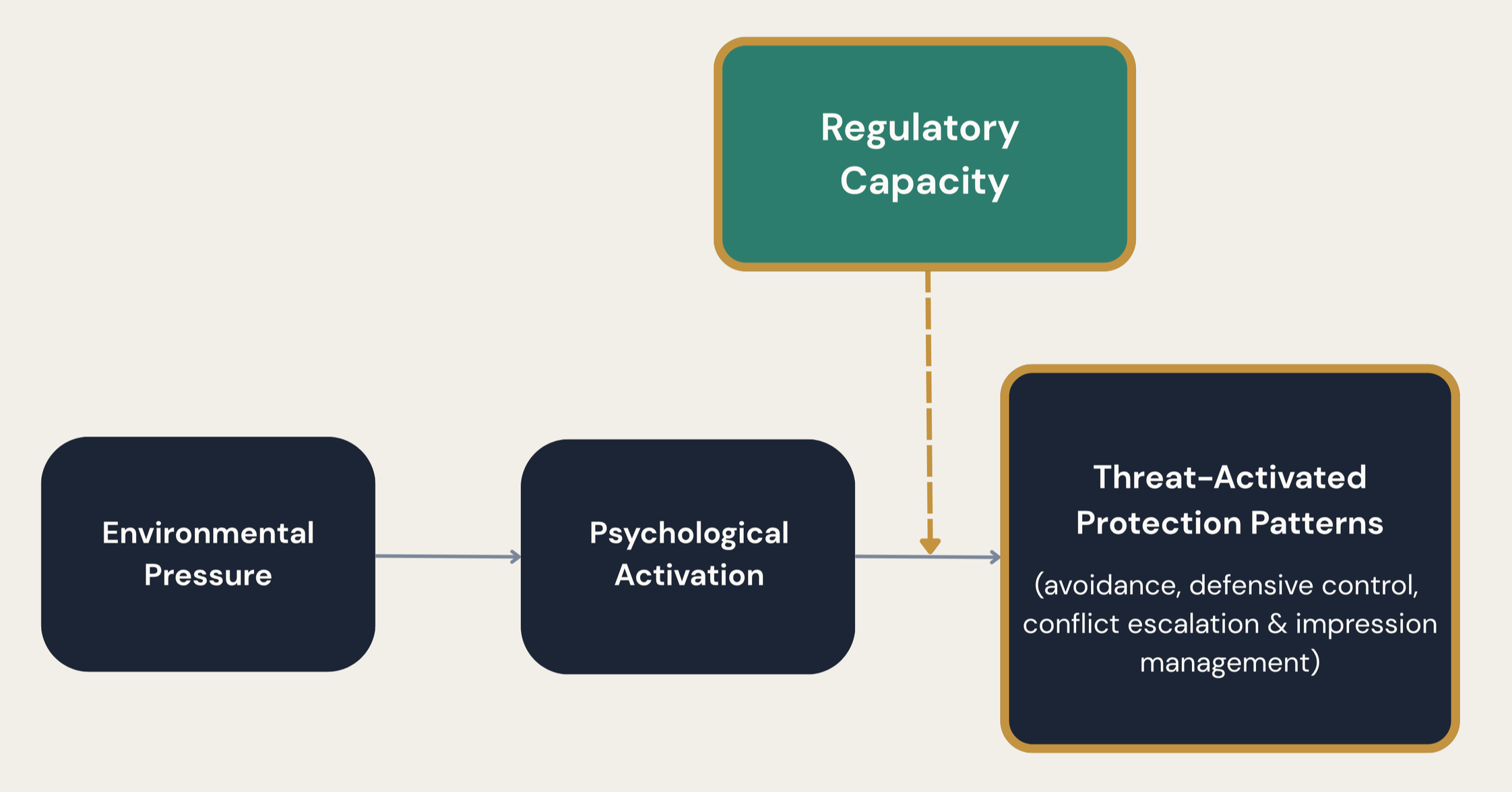
Emotional, cognitive, and behavioral responses that emerge when activation exceeds regulatory capacity.
Under pressure, leader don’t lose their principles. A protection pattern gets there first.
The elephant in the room that everyone’s too scared to name. The defensive answer when a colleague is asked about a recent oversight. The micromanaging boss demanding to know everything you’re doing and why.
These patterns aim to reduce threat in the moment. They provide temporary relief — from public embarrassment, interpersonal conflict, reputation risk, or the feeling of being out of control. Even when they contradict values.
These behaviors make sense. At some point, they were adaptive.
Sometimes these behaviors are still adaptive. Sometimes they are costly. Distinguishing between the two is essential.
Leaders are often unaware of their patterns — shaped, often unconsciously, by what they’ve learned and now seemingly automatic.
Each leader has a distinct history that shapes their emotional sensitivities, cognitive biases, and interpersonal styles. What they learned — at their last job, growing up, in relationships — contributes to current behavior.
And in their current environment — following praise for not mentioning the executive’s mishap, financial incentives for quick decision-making, and approval for agreeing during the strategic meeting — these patterns receive continued reinforcement.
Each time these patterns work, they are more likely to recur. In high-pressure leadership environments that elevate psychological activation and exceed regulatory capacity, leaders default to protective responses. The more stress, the more these behaviors occur.
Over time, short-term relief is prioritized over long-term alignment.
The intention-behavior gap emerges.
When leaders perceive a situation as threatening — sensing tension, observing judgment, noticing friction — activation rapidly organizes attention, cognition, and behavior. Regulatory capacity determines whether automatic impulses translate into protective responses or principled action.
Developing regulatory capacity starts with awareness — that these threat-activated responses exist, are automatic, and undermine alignment. Awareness makes it possible to identify which protective responses are ineffective and what, specifically, needs to change.
The process of understanding is vulnerable. Exploring protective patterns surfaces uncomfortable emotions. Most often shame, which causes leaders to conceal the brutal facts and look elsewhere. This prevents effective change.
Understanding needs to be paired with validation: acknowledgment that these behaviors were previously adaptive. That they make sense. That they are not character flaws. Acceptance of these behaviors as the result of a leader’s environment — not of who they are — creates the conditions for something different.
Awareness and understanding of threat-activated responses build motivation strengthen regulatory capacity. And regulatory capacity is the pathway to interrupting habitual threat responses before they take hold.
Leaders who develop sufficient regulatory capacity can redirect behavior patterns. This looks like pausing before responding. Reflecting on assumptions. Inhibiting automatic reactions. And acting in alignment with their principles — under pressure, when it’s hardest.