The Case for Regulatory Capacity:
Maintaining principle-consistent behavior under pressure.
Leadership Effectiveness = Principles × Regulatory Capacity
The multiplication matters. If regulatory capacity approaches zero, it doesn't matter how clear your values are or how much you genuinely want to lead well. Execution collapses. That’s the intention-behavior gap.
We’ve all been there. It happens in the last meeting of the day, right after a strongly worded email from your boss, when you hope the colleague who always talks too much wraps it up so you can leave before traffic gets crazy. They say something that you think is stupid, and instead of keeping your thoughts to yourself, you say, “well that’s the way to say goodbye to more revenue.” You know immediately as the words leave your mouth they won’t land well. And, in the moment, you’re almost too irritated to care.
You watch the shame appear on the colleague’s face. You see another coworker raise their eyebrows at you, communicating that it wasn’t the best move. But the colleague stopped talking, and you’re able to leave work on time.
Maybe you think about the situation later and feel some uncomfortable guilt, hoping to do better in the future. Maybe you don’t. Either way, you communicated to your team that expressing ideas openly isn’t safe. Trust decreases. And space for innovative thinking diminishes, as people fear their thoughts won’t be handled respectfully.
Leaders fail because they struggle to regulate under pressure. This is where the intention-behavior gap lives.
They opt for short-term relief — acting against their values in the process. This relief reinforces avoidance. When organizations incentivize speed and conflict minimization, these behaviors are systemically reinforced as well.
So the pattern of behavior continues. Brutal facts are ignored. Necessary change stalls. Outcomes suffer. And these patterns become harder to break — especially in uncertain conditions.
Leaders want long-term values alignment. The lingering guilt felt following values-inconsistent behavior is unpleasant. They often shame and blame themselves, expecting it to produce different behavior next time. But shame increases distress — and more distress means more of the same.
What regulatory capacity actually is.
Regulatory capacity changes the equation. It’s the ability to maintain goal-consistent behavior under pressure. To notice what’s happening, tolerate discomfort, and choose deliberately rather than automatically. It explains why the same leader who performs well in low-stakes environments falls apart when the pressure is real. And it's developable.
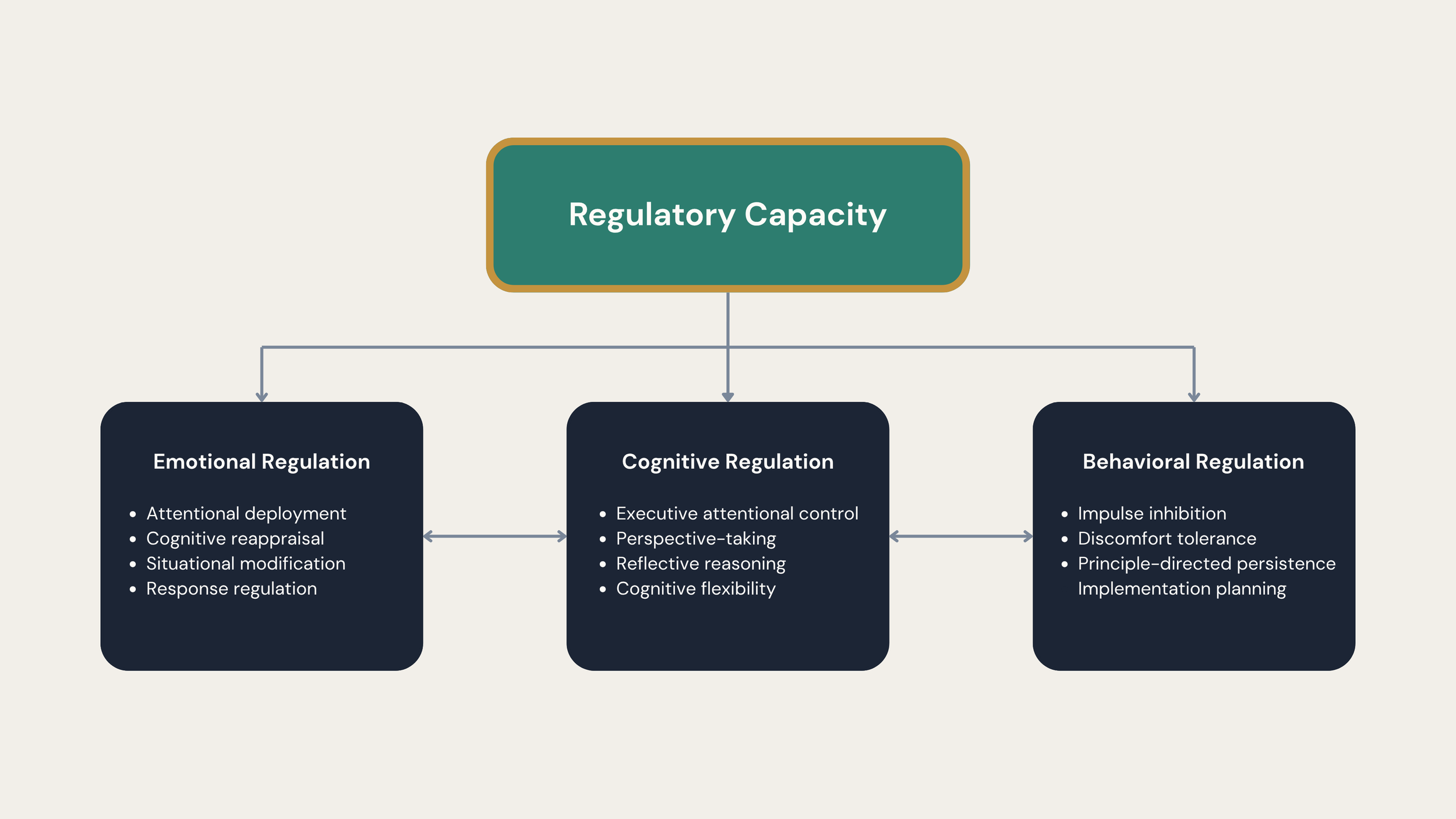
Regulatory capacity is not a single thing. It emerges through three coordinated systems.
Emotional regulation: modulates intensity — the volume of what you’re feeling and where your attention goes. It keeps you mindful of emotions when pressure wants to broadcast them, loudly.
Cognitive regulation: governs interpretation and reflective reasoning. It keeps automatic thoughts open to examination when pressure pushes toward rigid, habitual explanations.
Behavioral regulation: drives goal-directed action despite competing impulses. It keeps behavior consistent with what you want long-term, especially when pressure makes the easier thing more appealing.
These systems operate together. When one is overwhelmed, the others feel it. The intention-behavior gap emerges when regulatory demands exceed capacity across all three.
Leadership development frameworks define what effective leaders do, assuming consistent execution under pressure. At the end of a hard day, in a meeting with a difficult colleague, when AI threatens to take your job.
These frameworks don’t account for the moment activation overrides intention.
In leadership environments filled with economic instability, competing priorities, interpersonal conflict, and reputational stakes, all three systems face consistent demand. When regulatory capacity is ignored, leaders default to behaviors that avoid discomfort. Rigid. Habitual.
The intention-behavior gap is the product of automatic, threat-activated protection patterns.
This is why regulatory capacity — not resilience, not emotional intelligence, not mindset — is the central construct. Those matter. And none of them specify the mechanism.
The formula isn't motivational. It's mechanical. And that's exactly what makes it useful.
If the gap between knowing and doing is a capacity problem, not a character problem, the focus shifts. It's no longer wondering why leaders don’t do better. It’s identifying what needs to be built.
The central challenge in leadership isn’t identifying effective behaviors. It’s building the capacity to execute them when regulatory demands are depleted.