The Components of Regulated Leadership:
Principles. Environmental Pressure. Psychological Activation. Regulatory Capacity. Threat-Activated Protection Patterns. Leadership Behavior. Reinforcement. Team and Organizational Outcomes.
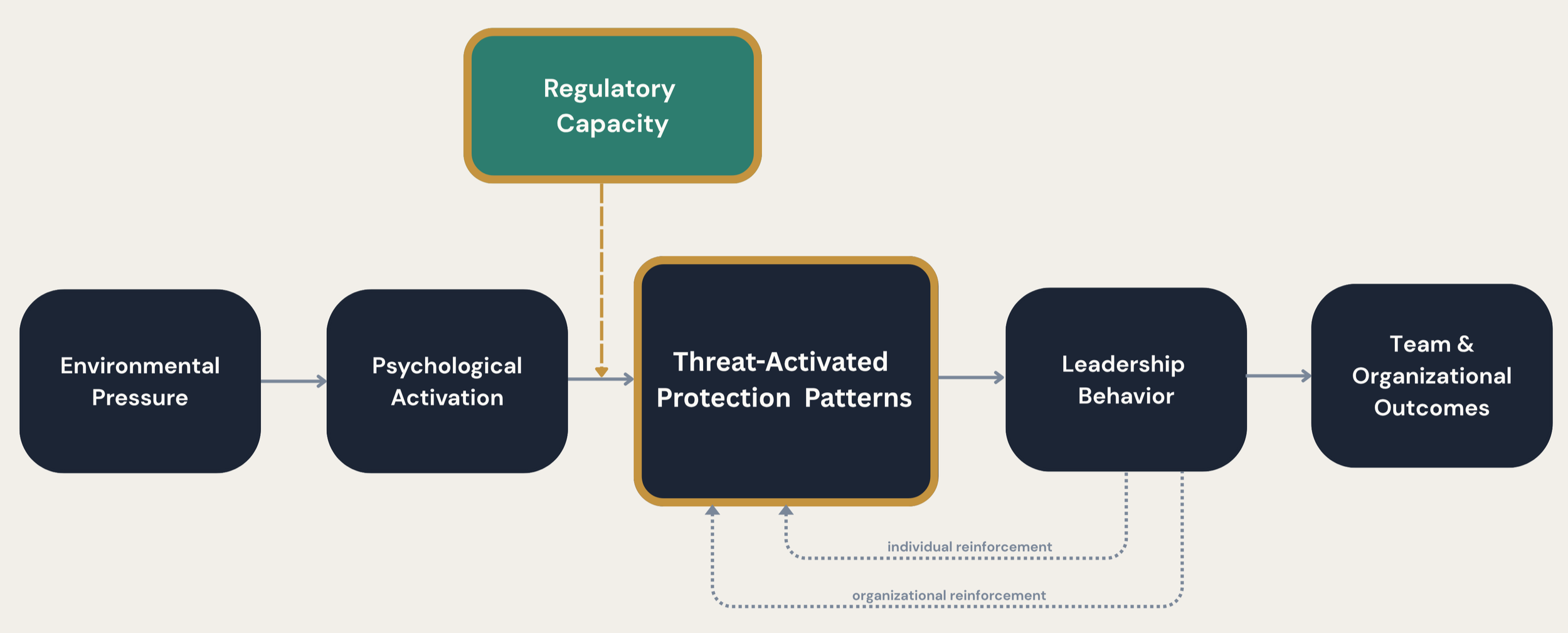
Environmental pressure elevates psychological activation. Regulatory capacity determines how activation translates into protective behavior — or principled action.
What leaders know and value. The standards against which behavior is measured — the reference point that makes misalignment visible.
External factors — uncertainty, complexity, ambiguity, interpersonal conflict — that activate psychological threat. The conditions under which regulated leadership is tested.
The stress, anxiety, and arousal that emerges under elevated environmental pressure. The state in which regulatory capacity is most needed — and most strained.
The ability to maintain goal-consistent behavior across cognitive, emotional, and behavioral domains under activation. The central capacity of the framework.
Explore this concept →Learned, automatic emotional, cognitive, and behavioral responses — avoidance, defensive control, conflict escalation, impression management — that emerge when activation exceeds regulatory capacity.
Explore this concept →What leaders actually do — whether behavior is aligned or misaligned with their stated principles. The visible output of everything that precedes it.
Behavioral alignment occurs when regulatory capacity is sufficient to meet situational demands. Principled action is possible. The leader's behavior reflects their values — not in the absence of pressure, but in spite of it.
Behavioral misalignment occurs when regulatory demands exceed capacity, increasing reliance on automatic, threat-activated responses. Under sustained demands, regulatory capacity becomes strained — increasing the likelihood that habitual responses override principled behavior.
The mechanisms that sustain threat-activated protection patterns over time — making them more likely to recur, even when they undermine principled behavior.
Protection patterns are reinforced at the individual level by the short-term relief they provide from internal distress. The pattern works — in the moment — and that is enough to strengthen it.
Protection patterns are reinforced at the organizational level through rewards, incentives, and feedback that — intentionally or not — signal that threat-activated behavior is acceptable, expected, or effective.
What follows from leadership behavior — culture, trust, performance, and the conditions that shape whether teams can do their best work. The consequence of how regulated leadership is.