Regulated Leadership: The Execution of Behavioral Integrity.
WHAT IT IS
Regulated Leadership is the capacity to execute principled behavior under pressure.
The challenge isn’t knowledge or intention. It’s execution — in the meeting that’s gone sideways, the conversation you’ve been dreading, the moment your nervous system has strong opinions about what happens next.
Most leadership development frameworks focus on what leaders should value and how they should behave. The framework focuses on the mechanism that makes principled execution possible under pressure.
The problem isn’t that leaders don’t know what effective leadership requires. It’s how they build the capacity to translate that knowledge into action, especially when the stakes are elevated and the environment works against them.
This framework provides the how.
THE MODEL
Regulatory capacity — the central construct in this framework — has three components. They work together. Disruption in one tends to affect the others. And all three can be deliberately developed.
Emotional processes are adaptive — they rapidly organize attention and action in response to threat. The problem isn't that leaders have emotions. It's that under pressure, emotional intensity can exceed the capacity to modulate it.
When that happens, behavior shifts — not toward stated values, but toward relief. Effective emotional regulation preserves the cognitive and interpersonal resources required for principled action.
Under threat, cognitive processing narrows. Thinking becomes faster, more rigid, more susceptible to bias. This is adaptive for short-term survival. It is not adaptive for leading teams through ambiguity.
Cognitive regulation keeps reflective reasoning available — the capacity to interrupt habitual interpretations, take perspective, and resist cognitive shortcuts when under pressure.
Knowing what to do and doing it are not the same thing. Behavioral regulation is the capacity to execute goal-directed action even when environmental pressure creates competing impulses — avoidance, defensive control, conflict escalation.
Not willpower. A practiced capacity that requires impulse inhibition, discomfort tolerance, and principle-directed persistence. Developable skills.
HOW IT WORKS
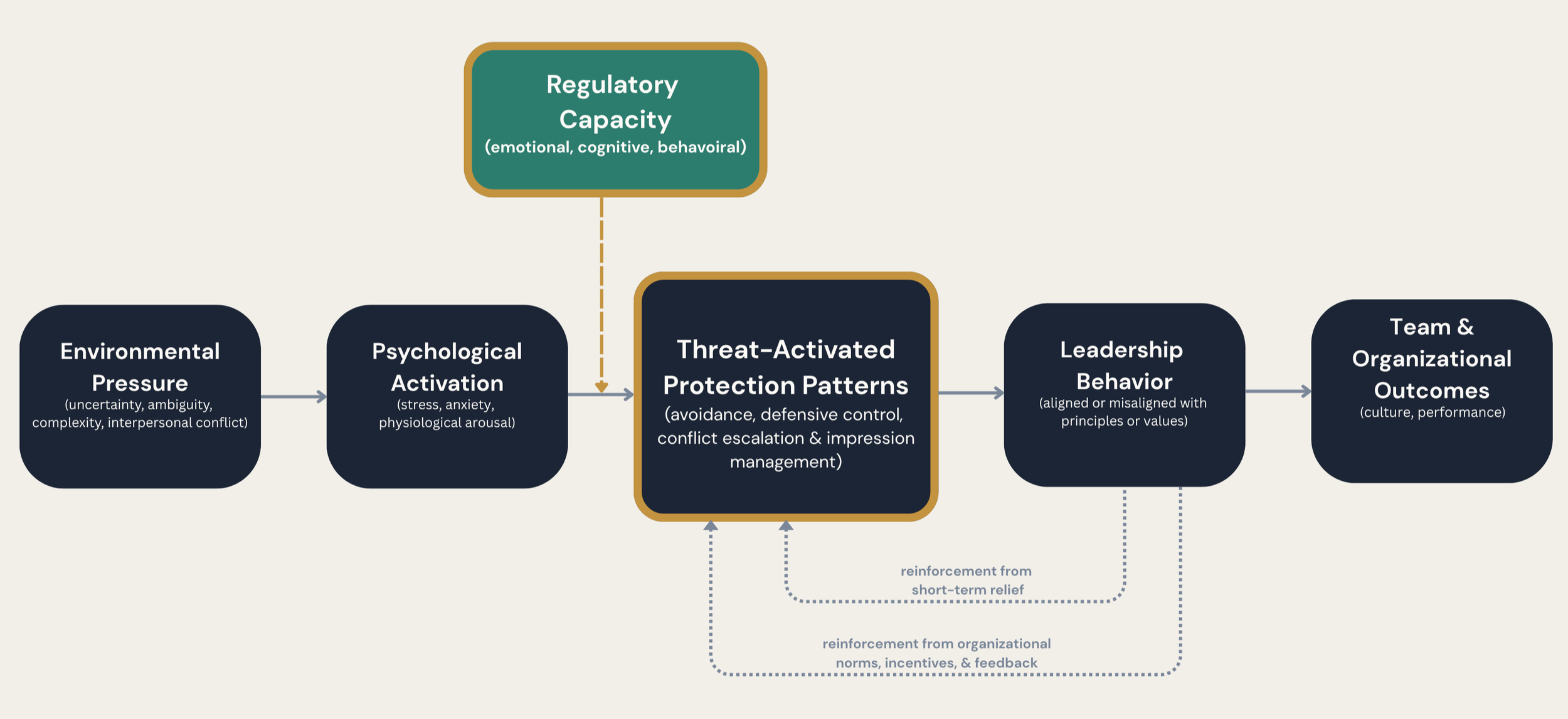
Environmental pressure elevates psychological activation. Regulatory capacity determines how that activation translates into protective behavior — or principled action.
WHAT GOES WRONG UNDER PRESSURE
When psychological activation is high and regulatory capacity is insufficient — when the demand exceeds what’s available — something predictable happens.
Behavior shifts. Not toward stated values. Toward relief from distress.
Not deliberately. Automatically. The nervous system defaults to patterns that reduce activation quickly. These patterns — once adaptive — emerge from past experience and are reinforced every time they reduce discomfort.
These are threat-activated protection patterns: learned, automatic responses that emerge when activation exceeds regulatory capacity. They show up as conflict avoidance, excessive control, defensive communication, blame-shifting, impression management. They are not evidence of poor character or insufficient commitment to leadership values.
They are exactly what leaders experience when the stakes are high.
The intention–behavior gap is a regulatory failure: emerging under pressure, reinforced over time, and without deliberate intervention, essentially automatic.
This distinction is critical for how to accurately approach leadership development. If the gap were a character problem, the solution would be accountability and values clarification. If it's a regulatory problem — which the evidence consistently suggests — the solution is building the capacity to intentionally regulate under elevated pressure.
HOW PRINCIPLES COLLAPSE
When regulatory capacity is exceeded, leadership failure isn't random — each core principle collapses toward a specific pole.
Not because leaders abandon their values. Because under pressure, the tension those principles require can no longer be held.
WHERE IT COMES FROM
Within clinical psychology, Dialectical Behavior Therapy (DBT) provides an operationalized framework for developing regulatory capacity across coordinated emotional, cognitive, and behavioral domains.
DBT was designed for clinical populations. The architecture — the skills, training structure, deliberate practice, consistent execution, and structured feedback — translates to non-clinical contexts. Research suggests that DBT skills training produces meaningful improvements in regulatory functioning across diverse, non-clinical populations.
This is what I find most interesting. The solution isn’t missing. It exists. It just wasn't designed for leaders.
THE CLINICAL FOUNDATION
Dialectical Behavior Therapy
Built to strengthen emotional, cognitive, and behavioral regulatory processes through structured skills training, repeated practice, and reinforcement across contexts. The Regulated Leadership framework draws on this architecture — not its clinical protocols; its approach to building regulatory capacity as a practiced, developable skill.
THE ARGUMENT
The framework is built on four arguments.
These arguments specify why the intention–behavior gap is a regulatory problem, what's missing in leadership development, and why DBT is the translation.
FOR RESEARCHERS & PRACTITIONERS
Read the working paper.
The full theoretical model — process-level mechanisms, the moderated mediation framework, and the taxonomy of principle collapse — is available as a working paper. Shared for interdisciplinary dialogue and continued refinement.