Relationships Are Regulatory Vessels
When do you get the most creative ideas? When do you develop the most insight? When do you have the most “aha!” moments?
For me, the answer is when I feel safe. When I am not concerned about judgment. When I am free to think openly, speak candidly, and question directly.
This isn’t just a personal preference. It’s basic human functioning.
The conditions that produce our best thinking aren’t accidental. They’re relational. And research supports this.
Organizations often focus on strategy, execution, and productivity.
What they often underinvest in is the mechanism that makes all of that possible: relationships.
Relationships are the conditions that shape whether people can execute what they know, especially under pressure.
The Harvard Study of Adult Development, one of the longest-running studies on human wellbeing, found that relationships are the strongest predictors of a good life. Not achievement, income, or status.
And it’s the quality and depth of relationships that matter the most – specifically, those that make people feel understood, safe, and valued.
These relationships are not free from conflict. They’re maintained during conflict – through mutual respect, productive disagreement, and timely repair.
As Robert Waldinger, the study’s current director, summarizes: prioritize connection over productivity, invest in emotional safety, and repair quickly after dispute.
Living a good life is not defined by what you achieve. It’s defined by who you’re connected to while you’re living it.
What creates a good life also creates a good company.
Amy Edmondson's research on psychological safety – the belief that you won't be punished for speaking up – consistently shows that teams with higher safety outperform those without it, across industries and contexts.
In psychologically safe environments, people share information, challenge assumptions, acknowledge mistakes, and correct course. Without it, they withhold, narrow, and defer.
The most creative ideas require space to be partially formed before they’re fully developed. Judgment closes that space.
The best ideas emerge in nonjudgmental environments – ones that foster innovation and strengthen collaboration.
As Simon Sinek states, team culture is the behavioral expression of values in relationships – and culture determines whether businesses thrive.
Performance isn’t fixed at the individual level. The same professionals perform better or worse depending on the team and relational environment they’re in.
The same person on a different team leads to different outcomes. The environment shapes behavior as much as the individual does.
The best leaders understand this and act accordingly.
Brené Brown notes that the best leaders don’t have all the answers – they ask essential questions and create space for perspective-taking.
Adam Grant emphasizes that the most meaningful way leaders succeed is by helping others succeed.
The best leaders want others to flourish – what Stephen Covey calls thinking win/win.
These beliefs converge on a shared principle: success doesn’t have to come at the expense of someone else.
Leadership effectiveness research confirms this. Task-focused and relationship-focused leadership aren’t opposites – they are complementary.
The strongest leaders integrate both. They hold high standards while creating conditions where meeting those standards is possible.
Effective leadership isn’t about control.
It’s about relationships – and providing opportunities for others to be their best.
This connects directly to regulation capacity.
Relational safety isn't just emotionally important – it's neurologically relevant.
Feeling safe in a relationship reduces perceived threat. It lowers psychological activation. It increases the capacity to think flexibly, regulate effectively, and act in alignment with principles under pressure.
Respectful, safe connection stabilizes the processes that allow for principled behavior under pressure. And behavior under pressure determines organizational performance.
Relationships are regulation vessels.
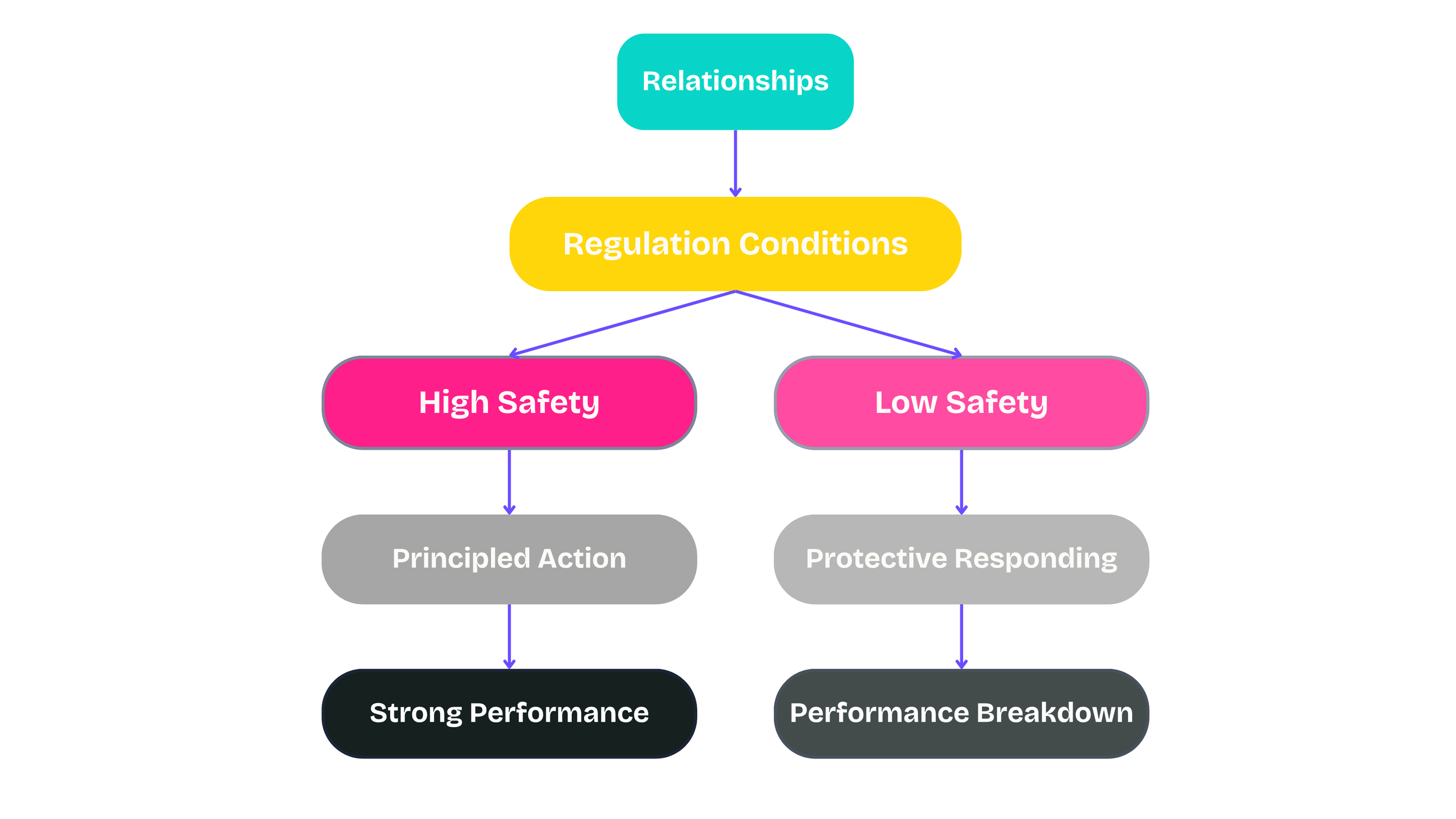
Relationships either stabilize or destabilize the systems that allow for effective action. They either increase the capacity to act with integrity or erode it. They shape whether people can do their best work when it's hardest to do so. They determine organizational wellbeing.
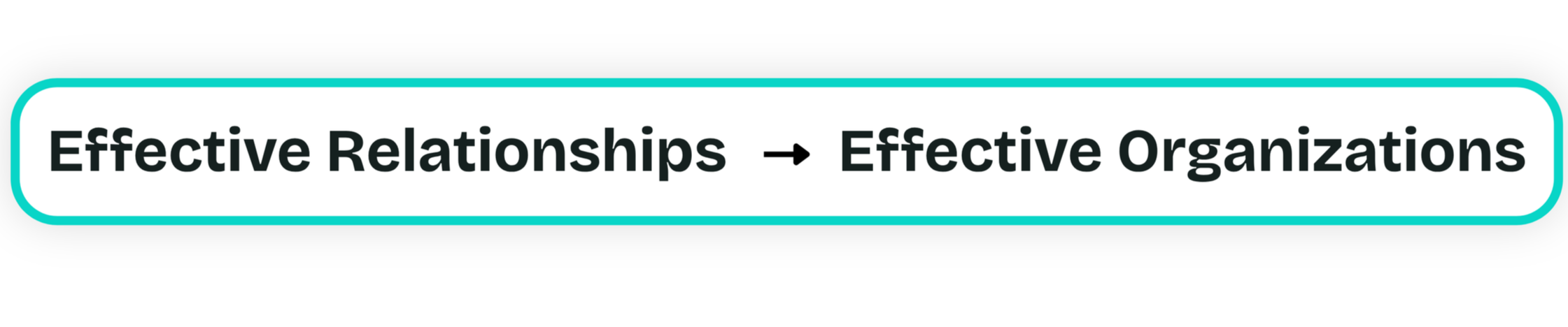
Effective organizations are not built on strategy alone. They require the conditions that make effective behavior possible: teams that can hold honestly without punishment, disagreement without rejection, and accountability without shame.
That requires leaders who understand that building relationships isn't separate from the work. It is the work.